
Performer of the Week: LaRoyce Hawkins Delivers an Emotional ‘Chicago P.D.’ Farewell


After 14 seasons of putting his life on the line, dealing with Hank Voight's questionable methods, and somehow managing to keep his sanity inside Intelligence, Kevin Atwater is finally choosing himself. Well, technically, he's choosing his family, but considering how much of his life he's given to the Chicago Police Department, we'd say the man has earned the right to put himself first for once.
The October 14 episode of Chicago P.D., "Don't Blink," marks LaRoyce Hawkins' final appearance as a series regular, and somebody really should have warned us to keep the tissues nearby. Hawkins doesn't need a dramatic death, a screaming match, or some outrageous last-minute twist to make Atwater's departure memorable. Instead, he delivers something even more satisfying: a performance that reminds us how much Kevin has grown and why saying goodbye to him hurts so much.
For bringing warmth, vulnerability, and emotional honesty to Atwater's final chapter, LaRoyce Hawkins is The TV Cave's Performer of the Week.
The Man Behind the Badge
One of Hawkins' greatest strengths throughout Chicago P.D. has been his ability to make Atwater feel like an actual person rather than just another cop running around Chicago with a gun. Kevin has always been loyal, compassionate, and willing to challenge things he believes are wrong, even when speaking up comes with consequences. Those qualities haven't disappeared in "Don't Blink," but Hawkins gives them a different meaning now that Atwater is a father.
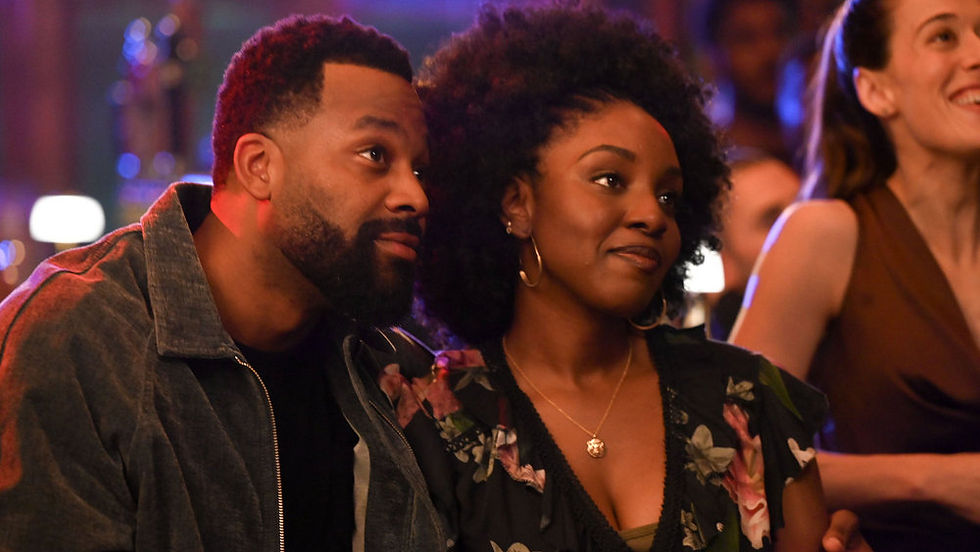
His moments with Tasha and their newborn son, Malcolm, reveal a gentler side of Kevin that feels completely natural. Hawkins brings an unmistakable warmth to those family interactions, showing us a man who isn't simply excited about becoming a father but genuinely amazed by the little person depending on him.
There's something especially touching about watching a character who has spent years protecting strangers discover an entirely different kind of responsibility. Hawkins doesn't play fatherhood like Kevin has suddenly become a new person. Instead, he makes it feel like Atwater has finally found something that brings all those years of sacrifice into perspective.
And honestly, after everything this man has been through, seeing him happy for five minutes shouldn't feel like such a luxury. But this is Chicago P.D., so naturally, peace and quiet don't last very long.
The Fear Hawkins Doesn't Have to Explain
The episode's most effective acting choices aren't necessarily the biggest ones. They're found in the contrast between Atwater's familiar professional confidence and the uncertainty that comes with realizing he has more to lose than ever before.
When Malcolm develops an ear infection and Tasha takes him to the hospital, Kevin is confronted with the uncomfortable reality that he can't always be where his family needs him. The baby is going to be fine, but that doesn't erase the feeling of having missed something important. What makes this material work is that Hawkins doesn't have to turn Kevin into an emotional wreck to communicate the conflict. Atwater still knows how to do his job, and he still wants to do it well. The problem is that he's beginning to question whether being good at his job is enough to justify everything the job demands from him.
Then comes the shooting. Atwater survives because his bulletproof vest does exactly what it's supposed to do, but Hawkins gives the aftermath more emotional significance than the physical danger itself. Kevin has faced bullets before. This time, however, there's a child at home who could have grown up without knowing his father.
That's the difference Hawkins brings to the performance. Atwater isn't suddenly afraid of being a police officer. He's becoming increasingly aware that every dangerous situation carries consequences for people who aren't standing beside him. And girl, when you have a newborn waiting at home, that's a realization that hits differently.
Sometimes Getting What You Want Isn't Enough
Hawkins' work opposite Jason Beghe becomes particularly meaningful when Atwater finally has the opportunity to receive the promotion he's wanted for years. Let's be clear: Kevin Atwater has earned that promotion several times over. After everything he's contributed to Intelligence, the fact that we're still talking about his advancement feels like somebody at the department needs to review a few personnel files.
But the interesting thing about Hawkins' performance is that Kevin doesn't react to the news the way we might have expected. The promotion represents professional recognition, yet Atwater is beginning to understand that recognition alone won't give him the life he wants. Hawkins brings a thoughtful restraint to this change in perspective. Kevin isn't bitter about his career, and he isn't dismissing the work that has defined so much of his adult life. He's simply realizing that his priorities have shifted, and the future he once imagined for himself doesn't look quite as appealing anymore.
His conversation with Voight carries additional weight because these two men have spent years developing a relationship built on trust, loyalty, and the occasional disagreement. Beghe's performance gives Hawkins room to explore Kevin's uncertainty without making the moment feel like a confrontation. There's no dramatic rebellion against Voight or the department. Kevin has reached a decision that comes from knowing himself better, and Hawkins makes that realization feel like a genuine achievement.
LaRoyce Hawkins Gives Atwater Something Better Than a Tragic Exit
One of the things that makes this farewell so refreshing is that Chicago P.D. doesn't punish Kevin for wanting a different life.
Television has a habit of sending beloved characters out with devastating deaths, sudden betrayals, or storylines designed to leave everybody miserable. Apparently, happiness doesn't always make for dramatic television. But Hawkins proves that a character choosing a better future can be just as powerful as watching everything fall apart.
Kevin's decision to move to Atlanta with Tasha and Malcolm, where he can teach at a police academy, gives him an opportunity to remain connected to the profession he loves without sacrificing the family he's building. Hawkins makes that choice feel hopeful rather than defeatist. It's also a fitting evolution for Atwater. He's spent years standing up for people who needed someone in their corner, and now he has the opportunity to guide future officers while being present for his son. That's not giving up on his purpose. It's finding another way to fulfill it. Hawkins understands the emotional significance of that decision, and his performance never suggests that Kevin is running away from anything. For once, he's running toward something.
A Farewell That Reminds Us Why Atwater Matters
By the time Atwater gathers with his Intelligence family for his farewell celebration, Hawkins has already done the emotional heavy lifting. We understand why Kevin is leaving, what he's gained, and what he's giving up. The goodbye doesn't need to manufacture additional heartbreak because the history between these characters is enough.
There's something genuinely moving about watching Atwater receive the love and appreciation he's earned. Hawkins brings a sense of gratitude to the farewell, allowing Kevin to acknowledge the people who helped shape his life without suggesting that leaving them means losing them. And can we appreciate that he gets to walk away on his own terms? No funeral. No tragic final assignment. No last-minute disaster designed to traumatize the entire Intelligence Unit. Just Kevin Atwater, his family, and the possibility of a future that doesn't require him to risk his life every Wednesday night.
We'll take it. What ultimately makes Hawkins our Performer of the Week isn't simply that he's leaving a show he's been part of since 2014. It's the way he makes Atwater's decision feel like the natural conclusion to everything we've watched this character experience. The warmth he brings to Kevin's family scenes, the uncertainty beneath his professional confidence, and the quiet conviction of his final decision all contribute to a performance that feels deeply connected to the character we've known for more than a decade. Hawkins doesn't ask us to feel sorry for Atwater. He gives us every reason to feel proud of him.
LaRoyce Hawkins gave Kevin Atwater 14 seasons of heart, integrity, and humanity. In "Don't Blink," he gives him something even better: a future worth looking forward to. And that is why he's The TV Cave's Performer of the Week.
Honorable Mentions
Linda Cardellini — Crystal Lake
Pamela Voorhees is hardly the poster child for healthy coping mechanisms, and Linda Cardellini is making sure we understand just how dangerous that can become. Her performance brings a disturbing combination of grief, emotional instability, and maternal obsession to Crystal Lake, giving Pamela moments of recognizable humanity even as her behavior becomes increasingly frightening. Cardellini doesn't rely solely on the character's horror legacy to make her unsettling; she makes Pamela's shifting emotions part of the threat. Somebody please get this woman some help before another person goes missing.
Sheryl Lee Ralph — Abbott Elementary
Barbara Howard has never needed to raise her voice to command a room, and Sheryl Lee Ralph continues to demonstrate why she's such an essential part of Abbott Elementary. In "Check-Ins," Barbara's handling of a sensitive situation involving a student allows Ralph to lean into the compassion and authority that make the character so special. Her performance is a reminder that being a great teacher isn't always about having the perfect answer. Sometimes it's about making a child feel understood, and Ralph knows exactly how to give those moments their emotional weight.
Jacqueline MacInnes Wood — The Bold and the Beautiful
Steffy Forrester has spent the week carrying a secret that could turn her marriage upside down, and Jacqueline MacInnes Wood makes that guilt increasingly difficult to ignore. Her October 16 scenes with Finn are particularly effective because Steffy wants forgiveness before she's even managed to explain what she's done. Wood brings fear and hesitation to the moment, making Steffy's internal struggle feel more compelling than the revelation itself. Girl, asking your husband to forgive you before telling him why is certainly a strategy, but we're not convinced it's a good one.
Which performace had you on the edge of your seat this week? Let us know in the comments.


Comments