
Law & Order: SVU Season 28 Premiere Recap: Benson Crosses a Line With Carisi

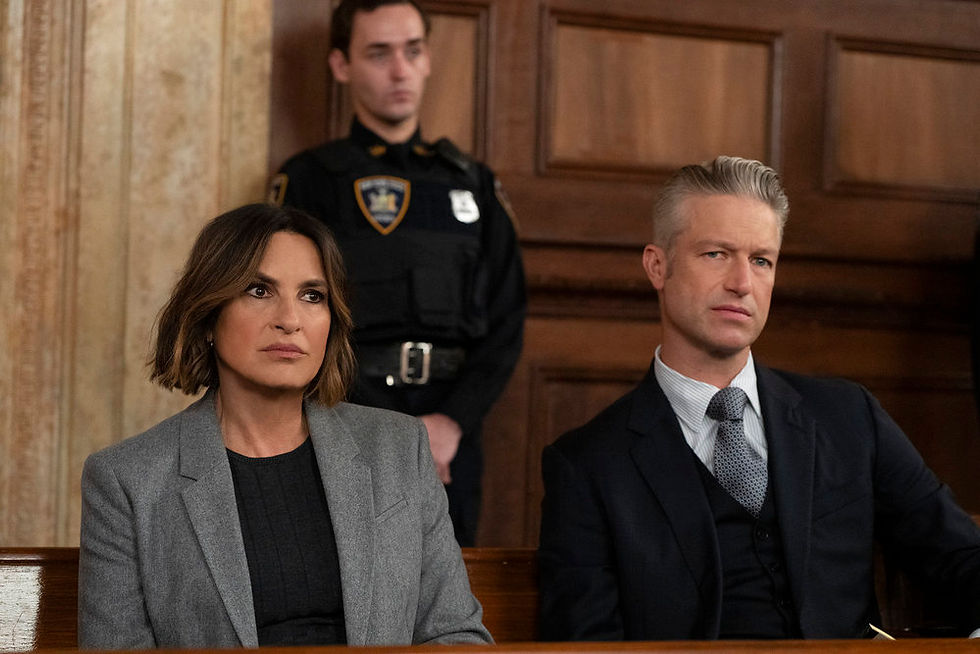
Spoiler Warning: This article contains spoilers for the Law & Order: SVU Season 28 premiere.
Olivia Benson has spent nearly three decades fighting for victims, and apparently she's reached the point where following the rules is becoming more of a suggestion than a requirement. The Season 28 premiere of Law & Order: SVU finds the captain frustrated with the justice system, questioning whether her work is actually making a difference, and making decisions that leave Carisi wondering what on earth has gotten into her.
And honestly, after almost 30 years of watching criminals find loopholes and victims struggle to get justice, it's not hard to understand why Benson is exhausted. That doesn't necessarily mean she gets to do whatever she wants, though, and "Volition" makes sure someone is there to remind her of that.
The season opens with a sexual assault case that exposes troubling issues surrounding consent and intoxication. While the
investigation itself is upsetting, it's Benson's response to the legal obstacles that ultimately creates the biggest conflict of the episode.
Olivia Benson Is Tired of Watching Victims Lose
The case centers on Emily, a young woman who reports being raped by three male friends while intoxicated. The men maintain that the encounter was consensual, forcing investigators to confront a legal distinction that makes the prosecution far more complicated than it should be.
Under the New York law discussed in the episode, voluntarily becoming intoxicated does not automatically establish the legal incapacity required for the prosecution's theory of rape. That means Emily's intoxication, however significant, isn't necessarily enough to prove the crime under the applicable legal standard. It's the kind of distinction that might make sense in a legal textbook but is devastating for someone who believes she was sexually assaulted and expects the justice system to protect her.
Benson knows the challenges facing Emily, and she's furious that the law leaves room for the accused men to argue that the encounter was consensual. The captain has seen far too many victims forced to defend their own behavior while the people accused of harming them walk into court insisting they did nothing wrong. After 28 seasons, some things apparently haven't changed nearly enough.
Carisi Has a New Coworker, and He's Already Annoyed
The prosecution introduces Assistant District Attorney Aidan Hawkins, played by Jelani Alladin, who joins Carisi in handling Emily's case. Hawkins may be new to the team, but Carisi doesn't seem particularly enthusiastic about his arrival.
The tension between them becomes noticeable during jury selection, where Benson also encounters Gwen Sharpe, played by J. Smith-Cameron. Gwen is an experienced jury consultant who immediately demonstrates that she knows how to read a courtroom. Without being asked, she offers Benson advice about which potential jurors the prosecution should avoid. It's a bold introduction, but Gwen clearly isn't someone who needs permission to share an opinion.
Carisi explains that she's a respected consultant who also spends time helping people who have been wrongfully convicted. Benson is intrigued, especially after Gwen warns that the prosecution may be walking into a trial it cannot win.
Unfortunately for Emily, Gwen knows what she's talking about. The jury eventually deadlocks, resulting in a mistrial. Despite everything Emily has endured, there is no conviction, and the legal process has left her feeling even more defeated.
Benson is understandably furious, but what makes the situation particularly heartbreaking is Emily's reaction. She begins questioning whether telling the truth about her intoxication has actually worked against her, wondering if a different account of what happened might have produced a better outcome. That's a devastating place for a victim to find herself, and it's exactly the kind of moment that makes Benson question whether the system she's devoted her life to is actually working.
Gwen Might Be Exactly What Benson Needs
Following the mistrial, Benson and Gwen spend time together outside the courtroom, giving the captain an opportunity to express frustrations that she's clearly been carrying for a long time.
Benson admits that after nearly 30 years, she's struggling with the realization that her unit cannot prevent these crimes from happening. Instead, they're left trying to help people put their lives back together afterward. Even when they secure a conviction, the damage has already been done.It's a revealing moment for a character who has spent so much of her life believing that continuing the fight is what matters.
Gwen doesn't dismiss Benson's concerns, but she also isn't interested in letting her surrender to them. Instead, she encourages the captain to reconsider how she approaches the fight for justice.
The conversation also reveals that Gwen has her own history connected to the kinds of cases Benson handles, although she isn't ready to share the details. Clearly, there's more to this woman than her ability to select a jury, and her growing connection with Benson could become one of the season's more interesting relationships. Unfortunately, Benson seems to interpret Gwen's encouragement as permission to get a little creative with the rulebook. And Carisi is about to have a very bad day.
Benson Takes Matters Into Her Own Hands
Rather than accept the mistrial as the end of Emily's case, Benson decides to pursue a strategy that puts pressure on one of the accused men. Working with Hawkins, she arranges for the arrest of the suspect's mother on charges involving witness tampering, obstruction of justice, and conspiracy. The intention is to pressure her son into cooperating with prosecutors against the other two men.
It's a questionable move, particularly because Benson and Hawkins understand that the charges against the mother are unlikely to hold up. The arrest is being used as leverage, and Benson knows Carisi would never willingly sign off on that approach. So, naturally, she goes around him.
Listen, nobody is questioning Olivia Benson's dedication to victims. The woman has been fighting for survivors since some of today's viewers were in diapers. But arresting someone's mother to force cooperation is a pretty significant line to cross, even when the ultimate goal is getting justice for someone who deserves it.
Carisi is furious when he discovers what happened, and his frustration goes beyond the questionable tactics themselves.
He believes Benson repeatedly behaves as though she's the only person who truly cares about victims, pushing for the outcome she wants without respecting the people responsible for prosecuting the cases. From his perspective, she's undermining his judgment and treating his professional concerns as obstacles rather than legitimate issues.
And for once, Benson doesn't have a particularly convincing answer.
She believes someone has to keep fighting when the system fails victims. Carisi doesn't disagree with that principle, but he's clearly tired of being treated like his own commitment to justice isn't enough.
The Conviction Comes With a Price
Benson's strategy ultimately works. Under pressure following his mother's arrest, one of the accused men agrees to cooperate with prosecutors. He testifies against the other two defendants, helping secure convictions for first-degree rape. In exchange for his cooperation, he accepts a plea agreement for second-degree rape.
Emily finally receives a measure of justice after an emotionally exhausting legal process, and Benson has achieved the outcome she was determined to secure. But just because something works doesn't automatically mean it was right.
That's the uncomfortable question hanging over the episode. Benson's tactics produced the result she wanted, but they also involved using another person's arrest as leverage. The premiere doesn't allow viewers to celebrate the convictions without considering how they were obtained. And Carisi certainly isn't in the mood to celebrate with Benson.
When she approaches him after the case concludes, his cold response makes it clear that their relationship has taken a hit. Whatever satisfaction he feels about the successful prosecution doesn't erase his anger over how Benson handled the situation. These two have known each other long enough that their disagreement feels especially significant. This isn't a new prosecutor struggling to understand Benson's passion. It's someone who knows exactly how far she's willing to go and is beginning to question whether she's gone too far.
Has Benson Finally Reached Her Breaking Point?
The most interesting thing about the SVU Season 28 premiere isn't that Benson bends the rules. She's never exactly been known for sitting quietly when she believes someone is being denied justice.
What's different is how personally she's taking the failures of the system. Benson isn't simply angry about one case. She's questioning whether the work she's devoted nearly 30 years to has accomplished enough, and that frustration seems to be pushing her toward increasingly risky decisions.
The arrival of Gwen offers an interesting possibility for the character. Benson has spent so much time being everyone else's source of strength that having someone who understands her professional exhaustion could be exactly what she needs. Whether Gwen becomes a positive influence or encourages Benson to make even more controversial decisions remains to be seen. Meanwhile, Carisi has every reason to be upset. His job is to prosecute cases within the boundaries of the law, and Benson's willingness to go around him doesn't exactly communicate trust or respect.
"Volition" begins the season with a successful prosecution but leaves one of the show's most important professional relationships in a difficult place. Benson got the conviction she wanted, Emily finally received justice, and Carisi is left wondering whether he can continue working with someone who seems increasingly willing to make the rules up as she goes.
Olivia Benson may have won this battle, but if she keeps pushing Carisi like this, she might find herself fighting the next one without him.
And after 28 seasons, that would be one partnership we'd hate to see fall apart.
Law & Order: SVU airs Thursdays at 9 p.m. ET on NBC, with episodes streaming the following day on Peacock.
What did you think?
Loved it
Hated it
So/So



Comments